
Paris, 17 November 2026.
Two centuries after its earliest technical experiments, photography continues to bring together those determined to capture time, without ever managing to stop the world from moving. From 12 to 15 November, the Grand Palais in Paris hosted the 29th edition of Paris Photo, an especially significant gathering marking the bicentenary of photography.
Since its foundation in 1997, Paris Photo has established itself as one of the world’s leading international gatherings dedicated to the photographic image. Galleries, artists, publishers, institutions and collectors converge at a fair that embraces both historical works and contemporary creations. Here, the chemical memory of the darkroom, the elegance of the photographic print and the possibilities of images created without negatives all coexist.
The 2026 edition was organised around five sectors: Principal, incorporating the large-scale Prismes projects; Voices; Digital; Emergence; and Editions. Together, they offered different perspectives on photographic creation, from established masters to emerging artists. Photography, despite repeated attempts to confine it to a museum cabinet, retains the rather inconvenient habit of reinventing itself.
The Voices sector was entrusted to guest curators Zasha Colah and Francesco Zanot, while Marco de Mutiis oversaw Digital. Their participation reflected a reality the art market understands perfectly well: photography can no longer be defined exclusively by a camera, a roll of film or a sheet of paper. Its territory has expanded, although artistic quality remains a considerably more complicated matter than the technology employed.
The Elles × Paris Photo programme, supported by the French Ministry of Culture, also continued its commitment to increasing the visibility of women photographers. It remains a necessary initiative in a history where many women made decisive contributions to photographic expression without always receiving the recognition they deserved.
The announced programme included conversations, publishing events, curatorial tours and the Paris Photo–Aperture PhotoBook Awards. Far from becoming an obsolete object in the age of screens, the photography book remains one of the most sophisticated ways of constructing a visual narrative. A carefully edited sequence of photographs can tell a story that a thousand scattered images may barely manage to suggest.
The organisers presented figures indicating the fair’s international scale: more than 220 exhibitors, representation from over 30 countries and an audience benchmark of 75,000 visitors. These figures illustrate the event’s established importance, although promotional statistics should not be confused with independently confirmed final attendance for the 2026 edition.
Naturally, wherever art and commerce meet, contradictions are never far behind. A photograph may be a historical document, a social testimony, an artistic expression or a commodity commanding a considerable price. Sometimes it manages to be all four. Yet price is no certificate of artistic significance, however enthusiastically certain catalogues and auction labels might suggest otherwise.
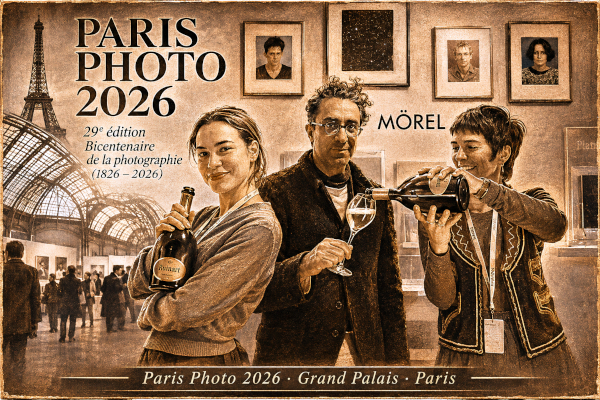
But there is another kind of photography, less ceremonial and perhaps considerably more sincere: the photography that records the people who make such gatherings possible. At the MÖREL stand, a photograph taken during the closing celebrations captures three participants sharing a toast. Among them is Berenice, a young woman serving champagne with the effortless grace of someone who understands that culture is also built through conversations, work and ordinary human gestures.
And perhaps that is one of the finest conclusions to Paris Photo 2026. Two hundred years after light first began leaving lasting traces on sensitive surfaces, we continue taking photographs for one essential reason: we know that moments disappear. The champagne runs out, the doors of the Grand Palais close and visitors return to their cities. The photograph, however, remains.
© 🖋️ By The Witness of Time | 2026 — All Rights Reserved
Also available in other languages:: 🇮🇹 Italiano – 🇬🇧 English – 🇦🇷Spanish –© 2026 SalaStampa.eu, world press service – All Rights Reserved – Guzzo Photos & Graphic Publications – Registro Editori e Stampatori n. 1441 Turin, Italy
Photograph: Closing celebrations at the MÖREL stand during Paris Photo 2026, with Berenice serving champagne alongside her colleagues. Paris, 15 November 2026. Family archive.
Sources consulted: Paris Photo 2026 institutional information and photograph supplied to the editorial team.
Editorial note: participation figures are based on the fair’s published reference statistics and should not be interpreted as independently verified final results for 2026