
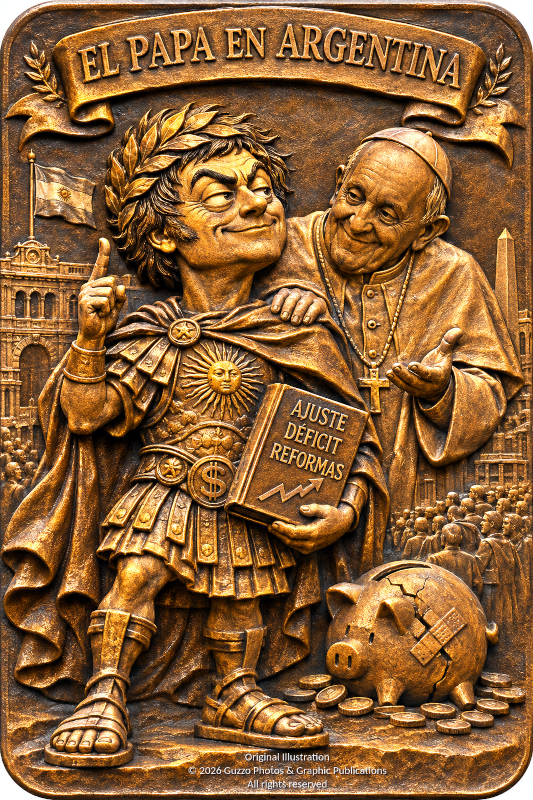
Buenos Aires — Javier Milei has declared that Pope Leo XIV’s prospective visit to Argentina will bring “immense joy and spiritual enrichment” to the country’s people. Speaking at the Jesús es Rey Evangelical Baptist Church in Neuquén, the Argentine president also reaffirmed his commitment to Judeo-Christian values. The prospect of a papal visit is certainly welcome. It also provides an excellent opportunity to examine a rather earthly question: what relationship exists between the principles politicians proclaim and the policies they actually pursue?
Milei assured his audience that Argentinians would welcome the Pope with open arms. A generous sentiment, particularly from a political leader whose rhetoric has not always been noted for its warmth towards those who disagree with him. Perhaps the spiritual influence of Rome might encourage a discovery that democratic life has long awaited: a political opponent is not necessarily an enemy.
The president also maintained that respecting rights requires perseverance, patience and conviction. Few would quarrel with such a proposition. The difficulty begins when those rights leave the comfort of a political speech and arrive at a pensioner’s doorstep, a hospital’s accounts department or a family’s kitchen table. It is there that grand declarations tend to lose some of their sparkle.
Milei defended fiscal balance by arguing that it is unjust to burden future generations with debt or punish the vulnerable through inflation. It is a reasonable argument. Responsible public finances are an obligation of government. But fiscal discipline cannot automatically be regarded as a moral achievement, irrespective of who bears its consequences. Balanced accounts, however desirable, do not necessarily produce a balanced society.
The Catholic Church’s social teaching, which no president is obliged to adopt as an economic programme, nevertheless provides an interesting reference point for anyone publicly invoking Christian values. It emphasises human dignity, solidarity, the common good and particular concern for the vulnerable. It does not instruct governments to spend recklessly. It demands something rather more inconvenient: that human beings should not disappear behind the figures.
During his address, Milei also claimed that his administration had fulfilled every electoral promise and that his chosen course would prevent a return to populism. Such political assertions deserve to be measured against verifiable results. Electoral promises, unlike articles of faith, are open to examination. Nor does any government acquire a monopoly on wisdom merely by declaring itself the sworn enemy of its predecessors’ mistakes.
The prospect of Leo XIV visiting Argentina offers an exceptional opportunity to reflect upon justice, individual responsibility and collective obligations. It would be unfortunate if such an occasion were reduced to a ceremonial photograph, a diplomatic welcome or an opportunity to dress economic decisions in the language of religious conviction.
It is worth remembering that the Gospel contains no instructions for running a central bank, nor any formula for calculating a budget deficit. It prescribes no particular tax system. Yet it repeatedly insists upon the dignity of the poor, compassion and the obligation not to abandon one’s neighbour. These are rather awkward teachings for any ideology seeking to claim exclusive ownership of Christian morality.
The president is perfectly entitled to defend his economic convictions and express his religious beliefs. Citizens possess an equally important right: to question whether the exercise of political power is consistent with the principles invoked in its defence. Faith may inspire a statesman, but it cannot replace accountability. And social justice, however inconvenient the expression may be to certain political movements, does not simply vanish because someone chooses to give it another name.
When Leo XIV arrives in Argentina, should the visit go ahead, he will encounter a society marked by hope, division and human needs that cannot be compressed into a political slogan. Perhaps the occasion will provide an opportunity to recall one elementary distinction: the chainsaw may be an instrument of economic policy; the Gospel, however, was never intended as its instruction manual.
© 🖋️ By The Assessor of the Narrative | 2026 — All Rights Reserved
© 2026 SalaStampa.eu, world press service – All Rights Reserved – Guzzo Photos & Graphic Publications – Registro Editori e Stampatori n. 1441 Turin, Italy
Sources consulted: Agencia Noticias Argentinas (NA), 31 October 2026 report on Javier Milei’s remarks in Neuquén. Catholic social teaching, as a conceptual reference. Presidential statements are attributed to the NA report.