
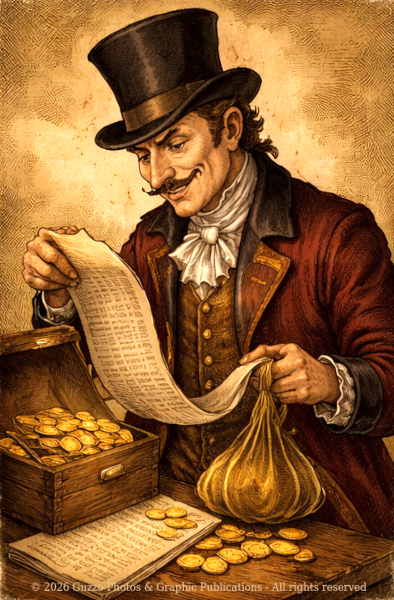
Some buildings are made to host meetings. Others, if only they could speak, would force everyone inside to stop for half an hour and listen.
The Château de la Muette in Paris decidedly belongs to the second category.
Today it welcomes politicians, ministers, governors, business leaders and international companies discussing investment, energy, mining, oil, trade and that perpetually sought-after, rarely domesticated creature called capital.
But long before the folders, presentations and speeches about investment opportunities arrived, there was a man named Henri James Nathaniel Charles de Rothschild.
And he deserves a moment of our attention.
Born in Paris in 1872 and descended from the English branch of one of Europe’s most celebrated financial families, Henri de Rothschild could quite comfortably have spent his life managing a famous surname, a considerable fortune and some very fine carpets.
He did not.
He studied medicine and received his doctorate in 1898. He developed a particular interest in paediatrics, published numerous scientific papers, supported medical institutions and became involved in public-health initiatives.
Medicine was not the decorative hobby of a millionaire wearing a white coat. Rothschild published more than a hundred medical works and made tangible contributions to paediatrics and public health.
He also put money where others are often content to put speeches.
In 1919, his foundation committed funding to cancer-treatment research conducted by Marie Curie and Claudius Regaud. Rothschild would later serve on the first board of the Fondation Curie, while financial support from him also helped make possible a dispensary inaugurated in 1922.
Not bad for a man whose surname tends immediately to conjure images of banks, drawing rooms and balance sheets.
But Henri still had several other lives available to him.
He wrote for the theatre under pseudonyms, including André Pascal, producing dozens of works. He became a theatre proprietor, loved automobiles at a time when driving one was still something of a mechanical adventure, and belonged to that remarkable European bourgeois world in which a man could move from laboratory to stage, from hospital to steering wheel, without first consulting the Human Resources department.
And he had, naturally, money.
A great deal of it.
In 1921 and 1922, he commissioned a new Paris residence near the Bois de Boulogne. Architect Lucien Hesse created the present Château de la Muette, drawing inspiration from the grand French residential tradition of the eighteenth century. Rothschild moved into the house in 1922.
There is a particularly delicious detail.
The rue André Pascal, on which the palace stands, bears the name of one of Rothschild’s literary pseudonyms.
The millionaire had achieved a small masterpiece: he managed to leave his name behind by hiding it.
Then History arrived, as History so often does, with the unpleasant habit of entering palaces without knocking.
During the Second World War, La Muette was occupied by the German Kriegsmarine. After the liberation of Paris it passed into Allied military hands.
Only a few years later, the private residence became part of the machinery of European reconstruction. In 1949, the Organisation for European Economic Co-operation established itself there in the era of the Marshall Plan. In 1961, that organisation became the OECD, which retains its headquarters at La Muette.
The transformation is magnificent.
A Rothschild built a house in which to live.
The Germans used it during a war.
The Allies passed through after liberation.
Europe turned it into a centre for economic cooperation.
And today governments and businessmen walk through its rooms to talk once again about investment.
This week, Argentina has arrived there too.
President Javier Milei, governors, officials and executives from major international companies are gathering in Paris for Argentina Week. There will be speeches, meetings, figures, promises, photographs and probably several kilometres of declarations about Argentina’s economic opportunities.
That belongs to the present.
But as delegations cross the rooms of La Muette, it is worth remembering, if only for a few seconds, the gentleman who commissioned those walls more than a century ago.
Henri James de Rothschild was born into an immense fortune, but apparently never considered inheritance sufficient as a curriculum vitae.
He studied medicine.
He financed hospitals.
He supported cancer research.
He wrote plays.
He raced automobiles.
He built a palace.
And then he allowed the century to do what centuries eventually do to the property of wealthy men: change its purpose.
There is perhaps a small irony in the fact that those rooms are once again filled with conversations about capital.
Because the man who built them left behind a rather more interesting lesson.
Money can open many doors.
The truly difficult question is deciding what to do once you have walked through them.
© 🖋️ El Testigo del Tiempo | 2026 — All Rights Reserved
Editions: Editions: 🇮🇹 Italiano – 🇬🇧 English – 🇦🇷 Spanish – 🇫🇷 Français –
© 2026 SalaStampa.eu, world press service – All Rights Reserved – Guzzo Photos & Graphic Publications – Registro Editori e Stampatori n. 1441 Turin, Italy
Sources consulted: Sources consulted: OECD; The Rothschild Archive; Musée Curie; Bibliothèque nationale de France.