
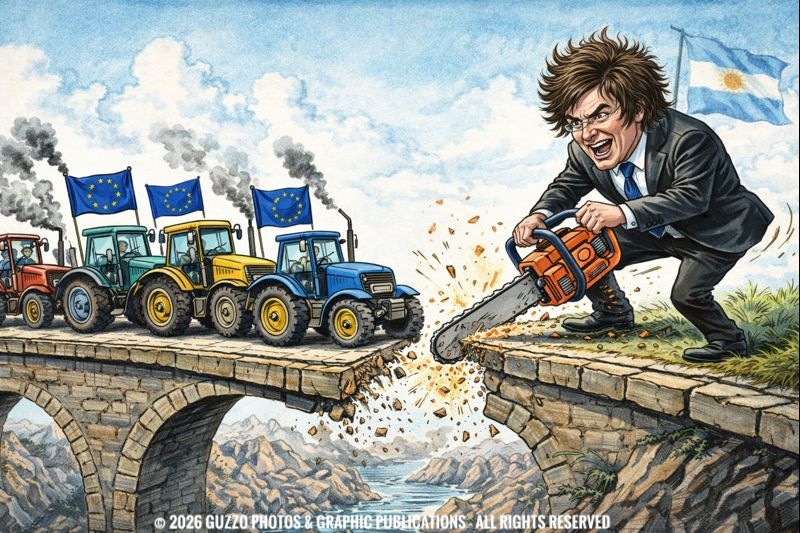
The European Parliament once again did what it does best when faced with a strategic decision: kicked the ball to Luxembourg and washed its hands. After a quarter century of talks, summits, handshakes and diplomatic smiles, the EU–Mercosur agreement was sent to the Court of Justice like a problem dumped in judicial storage to avoid responsibility.
Ursula von der Leyen had signed the text with ceremonial enthusiasm just days earlier, but the hemicycle decided that fine print matters more when tractors are parked outside. Ten votes were enough to freeze the process and publicly slap the European Commission.
In Strasbourg there was no solemn silence, only horns. Thousands of farmers celebrated the vote as if they had won a final, confirming that in the EU the rural veto still moves faster than any trade treaty. Food sovereignty—an elastic concept—once again served as a shield for old-school protectionism.
Brussels called for unity in the face of external threats—read Washington—but Parliament chose internal fragmentation. The message was simple: better to divide Europe than to defend an unpopular deal during campaign season. The result is an EU that negotiates like a global power and ratifies like a neighborhood assembly.
The vote reflected not ideology but well-mapped national fears. France, Poland, Romania and Greece hit the brakes; Germany, Spain and Italy checked their watches. The major political groups shattered like cheap glass, proving that European discipline exists mainly in press releases.
The left and the sovereignists, enemies on almost everything, discovered Mercosur as a perfect meeting point—not out of love for Latin American farmers, but out of domestic electoral convenience. Internationalism collapses quickly when it collides with the rural vote.
Now the debate hides behind legal technicalities. Provisional application is floated as the emergency exit no one wants to claim openly. For some it is pragmatism; for others, an institutional abuse. In reality, it is a confession: Europe cannot decide without asking for more time.
Meanwhile, Latin America watches patiently, having seen this film before. The message is clear: the EU signs, promises, then hesitates. And when it hesitates, it litigates. This is not foreign trade; it is institutional therapy.
Thus the EU–Mercosur agreement remains suspended in European limbo: neither dead nor alive, merely archived. Another monument to the political paralysis of a bloc that claims global stature but governs with local fear.
✍️ © 2026 The Cartography of Disorder — All rights reserved
© 2025 SalaStampa.eu, world press service – All Rights Reserved – Guzzo Photos & Graphic Publications – Registro Editori e Stampatori n. 1441 Turin, Italy